
Forgot About DRE
Reexamining the need for rectal exams in modern prostate cancer care

This is the first of a series of “mythbusters” posts - i.e. Simul takes on Oncolore. We will start with the need for a digital rectal exam. Is it a myth that we need to perform a DRE on our prostate cancer consults?
My med school girlfriend’s dad was a internationally known urologist - a great person, teacher and hilarious, as well. While scrubbed into a case, he’d say to a student suturing, “I’ve seen it done better, but never slower”. He told me there are two situations where a digital rectal exam would be contraindicated in a prostate cancer patient - 1) If the physician did not have a finger 2) If the patient did not have an a$$hole. HAHAHAHA! Dr. Swanson, thank you for giving me two great lines that I have used many, many times…
It was pointed out to me recently that I do not note DRE in my consultation note. This is true. I have not done one in an intact prostate case in a long time. I do time based billing and the exam is not necessary. So…
Do we need to stage our intact prostate cancer patients with a digital rectal exam? I have stopped doing them and I will explain why in this post. This is not laziness or an ick factor - though I do not like having one done on me, performing one is no sweat off my back. Patients are receptive (maybe once in my career a patient has said no) and it is part of the staging system. However, it has never, ever, ever changed my management of a patient. And, most people do not like having it done to them. It gives many of them anxiety and causes discomfort. When I had one done to me, the doctor looked at me and said, “I’m going to leave the room and give you a moment to compose yourself.” (TRUE STORY!)
Remember, these patients have likely come to you with 1) an elevated PSA 2) a biopsy 3) staging scans including mpMRI 4) possibly genetic testing like Prolaris / Decipher / Artera. At the very least, you are getting them with PSA elevation and a biopsy. With Gleason Group, PSA, % positive cores you are almost all the way there to place the patient into a risk group. The last step is the T stage which used to rely on DRE. However, many years ago, multiparametric MRI for prostate imaging was developed and has become nearly a standard of care. In fact, MROQC - our state quality program - requires it for radiation oncologists treating prostate cancer. At least one MRI needs to have been completed within 12 months of treatment to meet the metric. Every one of my patients gets an MRI, if they have not gotten one already. Typically, they get another one for treatment planning, especially if they have had a rectal spacer placed or if the imaging study was more than a few months ago. I have never said to myself, “Hmm, the MRI says ECE, but I didn’t feel it so I’m going to call this stage T1c”. Nor have I said, “The MRI shows the nodule contained in the base of the prostate, but I feel something outside the capsule, so this is T3)”. Why? Because the DRE is a shitty exam. Let’s go through the data.
There is a paper cited often (Cheng, et al J Urol 1998) that I cannot find on the internet. But, as I jumped down the rabbit hole I found an excellent prospective study comparing the two approaches.

What they found:
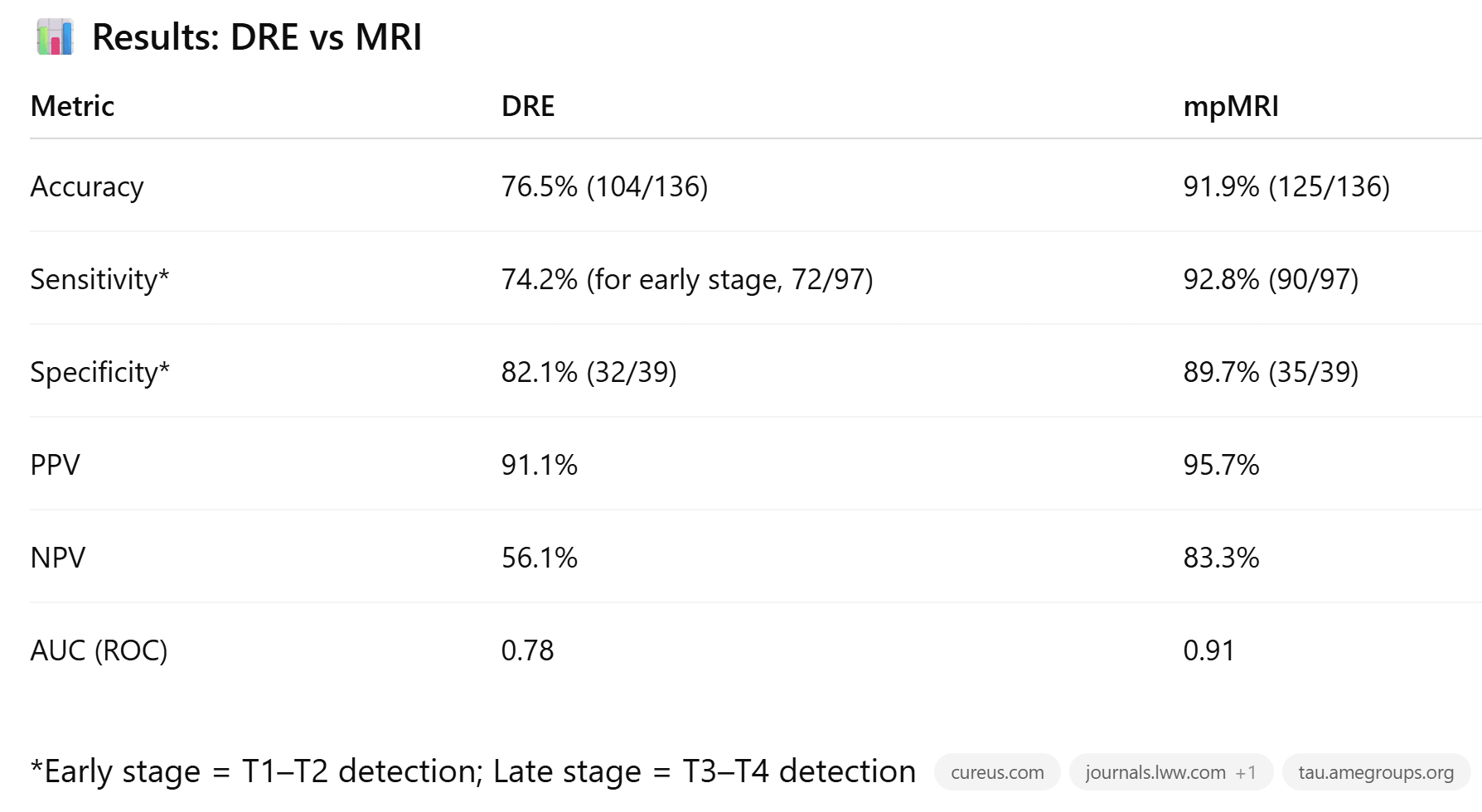
To summarize:
mpMRI is far more accurate than DRE for detecting both early and locally advanced prostate cancer.
DRE is modestly specific but has limited sensitivity and low negative predictive value.
The combination of DRE with mpMRI offers no additional predictive benefit over mpMRI alone in this cohort.
This is the key point. It is not adding any value.
Now, what about when they do happen to be discordant? Say you happen to be one of the doctors that still does a DRE. The mpMRI is negative or shows early stage disease, but your trusty finger detects ECE. Are you going to castrate this patient for 6 months to 3 years based on this? Now, I am going to add another very important variable … genomic testing. Are you all getting Decipher or Prolaris or Artera testing for your prostate cancer patients? You should! It is in the NCCN guidelines. Now, pretend you are this same doctor and not only do you have a negative MRI for T3 disease, the Decipher test is also telling you “single modality treatment”. Are you still going to castrate your patient based on a finger exam? Let’s turn it around - what if you did not feel a nodule, but the MRI shows ECE. Say your Decipher test is low. Are you going to not give ADT even though MRI shows ECE? I think it would be reasonable not to, but you would have to review the risks and benefits and document well. If you felt something, would that sway you to give ADT?
Remember, the number of false positives of DRE is significantly higher than the number of true positives. The data says that the PPV of a DRE is about 20-30%. The false positive rates is about 80% (here is a link, here is another). So, in a patient with prostate cancer, it is 2.6 - 4x more likely that the nodule is not malignant. It would be wise to disregard the finding and even wiser to stop doing the test, as the chance for a complication is higher than finding information that is still unlikely to change your management. There is not as good data for palpable ECE and accuracy numbers as there is for a nodule being positive or negative. My gut tells me it would be even less accurate, but even if it was about the same, it’s still not useful.
I can feel confident in saying that the DRE has almost no value in a patient already diagnosed with prostate cancer. Do note that I am not discussing patients that have not been diagnosed (this simply doesn’t apply to 99% of patients that radiation oncologists see), nor am I discussing patients that we see for recurrence after prostatectomy. If your patient has a sky high PSA, is not a candidate for biopsy or is refusing one, please do pull out the rubber gloves. If you feel a rock hard prostate or an ugly nodule and there are symptoms to palliate (bleeding, urinary obstruction, pain), I think it would be reasonable to consider treatment (though others would disagree).
Another rare case where I would do one is if the MRI or CT imaging shows concern of rectal invasion. If I was considering radiating this patient, I would definitely do a rectal exam to see if it was frankly invading through the rectal wall into the anorectal canal. If you have ever had a patient with this type of disease, it is abundantly clear upon DRE. I would not radiate this patient upfront. I would start with ADT +/- Xtandi and then re-image and re-examine, before leading this guy to fistula-town.
I also generally do them on patients that are coming to me for salvage therapy. Sometimes you can feel a nodule. If so and you can localize it, it may be worthwhile to give the nodule a definitive dose - I have done 66.6/74 Gy in 1.8/2.0 Gy/Fx. I’d be nervous to go much higher than this. The confounder here is that it is likely that if you can feel something and it’s real, it would also show up on PSMA-PET or other axial imaging, so maybe I should re-think this, particularly with modern imaging.
Now, what about the folks that tell you that you may pick up an anal or distal rectal cancer? Let’s look at the numbers:

Sure, you are going to have an attending tell you they picked up an anal cancer, but this is a moonshot. You would have to perform DREs on 11,000 patients to pick up one cancer. The NNT is shockingly high and we would never use a diagnostic test with this level of inaccuracy. This is Oncolore, pure and simple.
Now, the one case which this will not be true is the oral board exam. I am telling you right now loud and clear - tell them you will do the exam. The NCCN guidelines still say to do it, the people examining you are not going to be interested in your nuanced, patient-directed, evidence based decision making. This is not the time. You say yes to DRE. You say it with confidence. You say it with conviction. But your eyes can say: HELL NO.
I have queried several colleagues. Nearly no one I know does this routinely any more. Yet, it remains a part of training, a part of staging and is considered standard of care. Why? One thing is it may be part of the ritual of medicine. Often times, radiation oncologists play doctor and auscultate heart and lungs in a perfectly healthy prostate cancer patient, because patients may expect this sort of thing. I used to do this, as well, but I no longer do. Performing random physical exams on patients with no relevant complaints is a waste of everyone’s time. So is performing a test that is less accurate than other test that is routinely used (mpMRI) in conjunction with genomic testing (Deciper, Prolaris, Artera, etc.)
MYTH BUSTED!
Personal Note:
We went to see one of my favorite bands last week (Wild Rivers) and before the show, we got to meet with them. It was really cool! They are not celebrities (I bet most of you have never heard of them), but it was simply amazing to meet people that bring such joy into my life. We listen to them literally every day and I am happy to seem doing well - they played Lollapalooza this weekend, the day after our show - how cool!

Yup, DRE has left the bldg. Will never forget being severely reprimanded for failing to do one by the late Perez 25 years ago on a patient in routine postxrt follow up, as it was done on EVERY patient.
With mpMRI/PSA/PSMA/bx it seems ridiculous to do them..